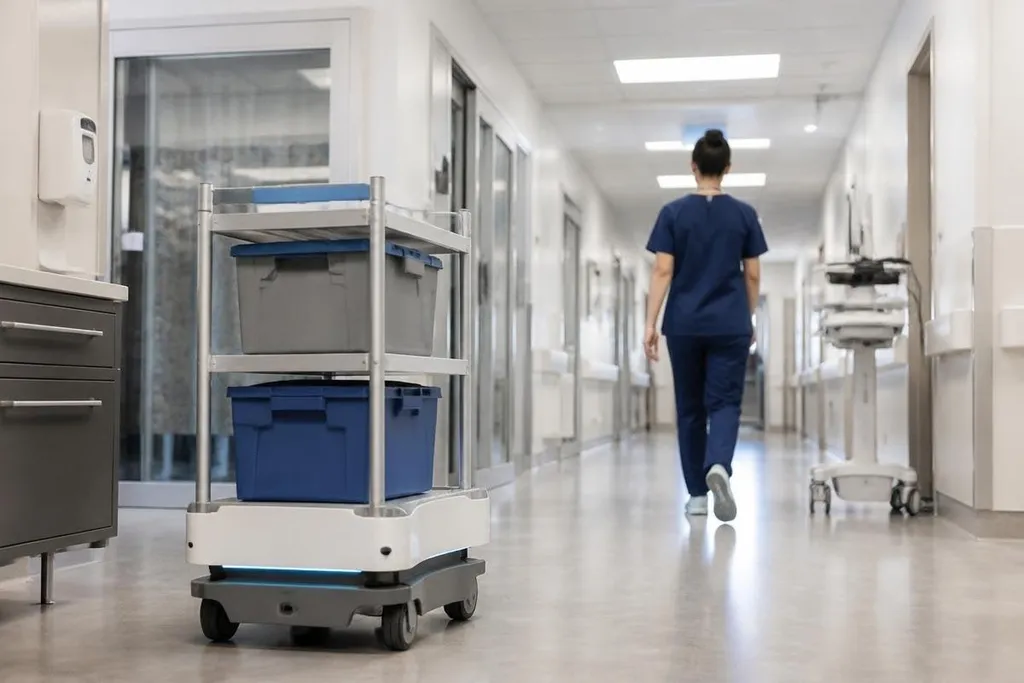
A hospital robot may move supplies, guide a mobile scanner, or help a patient stand. Each task matters because staff time is limited, and many hospital jobs involve long, repeated trips rather than medical judgment.
- Robots can move items through halls while staff stay with patients.
- Sensors and software help machines work around people and obstacles.
- The hard test is safe, useful work inside a busy hospital.
Hospitals have many repeat jobs
A nurse may spend part of a shift walking to collect medication, moving equipment, or finding a clean bed. A mobile robot can carry sealed supplies along set routes, then stop when a person or cart blocks its path.
That does not remove the need for staff. It assigns a narrow task to a machine instead of a trained worker, which can leave more time for checks, treatment, and conversation.
The value depends on the route, the load, and the time saved.
Other systems work in fixed places. A robotic arm can sort samples beside laboratory equipment. An automated pharmacy system can store packets, read labels, and send the right item to a pickup point. These jobs suit robots because the steps repeat and the work area can be controlled.
Robots can help with physical care
Some healthcare robots support movement rather than transport. A powered frame may help a person practice walking, while a robotic arm can guide a repeated exercise. The machine must respond to body position and force, so the software needs clear limits.
This is where sensors matter. Cameras can track posture, force sensors can detect contact, and emergency stops can cut motor power when movement goes wrong. Each part has a plain purpose: the robot must know where the person is, how hard it is pushing, and when to stop.
Care robots also raise a harder question than whether the hardware works. Patients may need touch, judgment, and reassurance from a person. A robot can support a therapy session, but it cannot replace the relationship that makes many care tasks work.
The hospital is a difficult workplace
Hospitals change from hour to hour. Doors open, beds move, floors get wet, visitors pause in corridors, and staff may need to pass quickly. A robot that works on a clear test route can struggle when those conditions change.
Navigation means building a map and using sensors to track position. In practice, a mobile robot may combine cameras, LiDAR, and wheel data to choose a safe path. It also needs a way to call for help when a route stays blocked.
Cleaning and infection control add another layer. A system that carries supplies must keep clean and used items apart. A machine that works near patients needs surfaces and parts that staff can clean without taking the robot out of service for long periods.
A hospital robot earns its place when staff can measure the work it completes and the time it saves. Reports on hospital robots from Robot 24 can tie those claims to named machines, sites, dates, and test results. That evidence leads to the next issue: what the system costs, and which results remain unproven.
Cost and proof matter
A hospital does not buy a robot for the label on its box. It needs to know what the system does each day, who runs it, how often staff intervene, and what happens when it stops.
The price also includes installation, software, training, service, charging, and changes to the building. A low purchase price can lose its appeal if the robot needs a person beside it for every trip.
I’d back a small task with clear results before a broad plan to automate care. A supply route or lab process is easier to measure than a promise that a robot will improve the whole hospital.
Use this check before a purchase:
- Name the task: Write down the exact job, route, load, and handoff.
- Count staff time: Measure walking, waiting, loading, and recovery after errors.
- Set safety rules: Define stopping points, human control, cleaning steps, and access limits.
- Test busy hours: Run the robot near beds, visitors, carts, doors, and blocked paths.
- Track the handoff: Record when staff must touch the robot or fix its work.
Healthcare robots are becoming more important because they can take on repeat work while staff handle care that needs judgment. The next useful proof is not a smoother demo; it is a hospital showing the task, the intervention rate, and the cost after regular use.